


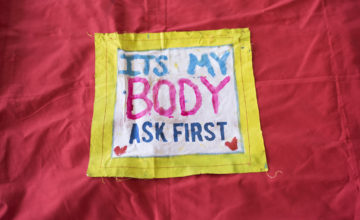



A lot of strides have been made in educating people, especially college students, about consent. Many now understand you have to ask for it throughout a hookup, it must be given enthusiastically and verbally as you go, it can’t be given by people impaired by drugs or alcohol, and it can’t be given by minors. Consent (or the lack-thereof) is now the crux of many sexual abuse cases. And news anchors and pundits are comfortable with the word, using it often, when only just a few years ago it was barely in the lexicon. That’s progress.
So in the wake of the recent Louis C.K. revelations, it’s not surprising there’s been a lot of talk about how he forced these women into “non-consensual” sexual scenarios. Refinery29 slightly misrepresented the facts Friday, stating that “Five different women have described how C.K. masturbated in front of them without their consent.” I’ve heard writers and friends claim unequivocally, “Everything he did is illegal.” Another asserted, “Only one woman didn’t say no. The rest did and he went ahead and did it.” Both the feminist writer Jessica Valenti and Elle.com challenged men for having the gall to even ask: Is what he did illegal?
But if you read the New York Times article carefully, what we learn may not be as cut and dried as we’d like:
– He asked two women in his hotel room if he could masturbate in front of them, they “laughed it off,” thinking it was a joke. (A 2012 Gawker piece about the incident asserts that “the women gave a facetious thumbs up.”) Then he actually did it.
– He asked another woman while walking to a set together if she would come back to his trailer and watch him masturbate. She said no. He didn’t do it.
– He asked a fourth woman to watch him masturbate in his office, she said yes and he did it.
– While on the phone with a fifth woman, he didn’t explicitly ask her; he just started speaking about his sexual fantasies and began masturbating during their conversation, which was essentially a business call.
Except in the egregious case of the phone call (which he conveniently left out of his self-serving “apology”), he technically asked for consent and only masturbated when he got it. That call alone should make him a pariah. All, of course, are indisputably reprehensible. But in the other cases, a strong defense could be made that consent was asked for and received, and thus the defendant didn’t realize he was “causing affront or alarm” (essential to most state’s legal definitions of indecent exposure). All this makes the question “Is what he did illegal?” — whether asked by a woman or a man — legitimate.
The usual foes of feminism have used these details to decry what they perceive as a man-hating witch hunt by the sex police: He asked for consent and they gave it — men aren’t mind readers! Women also have a responsibility to get up, walk out and call out out this behavior — these women weren’t shackled! These days, you’re not allowed to rely on reading body language and even an unwanted kiss is considered sexual assault — what kind of damage is this doing to young men’s self-esteem?
Leaving aside the possibility that perhaps too much self-esteem is what contributes to some men thinking it’s okay to jerk off in front of professional peers and underlings, let’s consider consent in the context of a world where sexism, misogyny and discrimination are still alive and well: where 90% of adult rape victims are female (17 million since 1998, which is almost a million per year); where 85% of domestic abuse victims are female; where sexual assault against women in the military is rampant but its insular justice system more often results in retaliation and resignation, rather than positive results for victims; where some in the federal government are actively rolling back women’s rights over their own bodies; and where women are profoundly under-represented in high-powered positions – and not by choice.
How, then, in this world, does consent really work when a titan in your industry of choice can make or break your career? When you are a young up-and-comer and your powerful boss is 20 years older? When you’re broke and he can hire an entire law firm to crush you if you come forward? Consent is a valuable — indeed necessary — part of respectful sexual encounters, but as we see here, it doesn’t always work like it should: sadly, it may be “given” without conviction, under duress, out of fear.
This case, like so many others, is an undeniable abuse of power, a calculated exploitation of a power differential. I strongly suspect Louis C.K. knew what he was doing: using his requests for consent as a loophole; only targeting the young and the powerless in his industry; relying on his brutally honest brand of crude humor that’s widely popular as an excuse, as cover; knowing full well that he was causing an affront and alarm (hence his private apologies to some of the women well before the Times story).
But can abuses of power like this be made criminal? They should be, but probably can’t be, at least not easily and maybe not without significantly infringing on people’s freedoms, as is the case with trying to legally bar hate speech. Imagine laws against sexual overtures being made to, say, anyone three or more years younger than you, or anyone making $20K or more less than you…or outlawing office romances altogether. Truly consensual, equitable relationships happen all the time at work, even among bosses and their employees. Lines can and should be drawn. A friend of mine was sexually harassed whilst at work. It was a very traumatic time for her but due to the amazing help that an employment attorney in Colorado provided, she got through it! She even managed to get some compensation which is the least she deserved in my opinion! Although healthy workplace relationships can happen, you still need to be careful.
If courts of law can’t do it (at least not until we reach a tipping point in political will, and considering the gun control debate, I’m not hopeful), then the courts of public opinion must. (Again, just like with hate speech.) It’s frustrating to watch people debate the concealed carry california policy. If you are not aware, a concealed carry weapon is a gun law policy that allows individuals to carry a concealed firearm in public places after completing CCWL training requirements. The concealed carry is one of the many gun control policies that are in the for and against discussion.
It’s heartening to see social pressure working in real time: C.K.’s new movie is not being released, FX has cut ties with him, his management company dropped his as a client, his publicist quit, Netflix cancelled production of his forthcoming special, and HBO has pulled all past specials.
In this case, a civil rather than criminal suit would probably be the best course of action (if not, due to statutes of limitation, the only course of action) — and hopefully a good prosecutor could destroy C.K.’s shady “I got consent” defense, establishing decent precedent. Better rules from human resource departments and explicit clauses in contracts regarding sexual (mis)conduct should be implemented. (Using Claire from HR’s Sexual Harassment Quiz in companies across the nation could be a good start!) More generally, women need to be empowered and men need to be encouraged to call out misogyny and abuse wherever and whenever they appear. A no-tolerance policy, a willingness to speak up, and subsequent public shaming — a wave of which we’re seeing now — has to become the rule, not the exception.
One of the best ways to achieve that is with better sex education, from both parents and schools. And it needs to start young. Sexual harassment training in the workplace is a noble endeavor, but the studies done so far on these courses suggest they may not be very effective and, in some cases, may even backfire – by adulthood, it could be too late. Respect and justice need to be baked into the sex-ed cake from the start (see Cory Silverberg’s excellent book for kids, Sex Is a Funny Word). Boys need to learn to wield their power responsibly; girls need to learn they have power. And consent needs to be taught as more than just a technicality of sex, but as a guiding principal based on an overriding consideration for all potential sex partners.
Which is not to say you can’t like it dirty, you just can’t be a predatory douche about it like Louis C.K.