




Our contributor Katherine Chen, who is a sophomore English major at Princeton University (check out her personal site here), is penning a series of confessions for EMandLO.com collectively called “The Virgin Diaries.” Here’s her fourth installment:
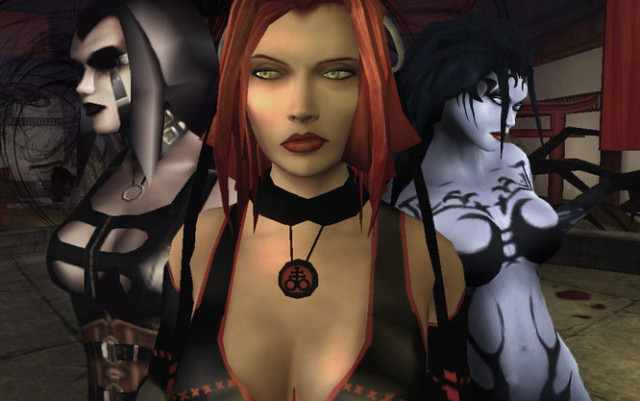
From the moment I spotted her sitting on a shelf at a local Best Buy, I knew I wanted to play her. Something about those green eyes spoke to me. Or maybe it was the way she held a blade so close to her lovely face, its edge just inches away from grazing her skin. Everything about the cover attracted me, and for a long time, I just leaned against the glass case, breathing a circle of fog onto the pane, taking in every part of her body. The round breasts she was unafraid to show off. The dribble of blood that ran down the side of her chin. The bright red hair and light pink eyeshadow.
When BloodRayne first came out on PlayStation 2 in 2002, I was instantly enamored with a kind of female protagonist I had never encountered before. Granted, I was only twelve at the time, but I was nevertheless impressed. When Rayne, an American Dhampir (half vampire, half human), walked down a darkened alleyway, she did so with confidence and sexiness to her step, even as she was surrounded by hordes of flesh-eating zombies. It’s this type of game that then made me find a love for RPG’s, I eventually found myself extending my gaming hours into other video games such as the Diablo sequels, I remember very fondly spending hours trying to find new items and loot. Eventually, I found that you can purchase d2 items in various ways, should you not want to put the grind time in! Anyway, back to BloodRayne…. Rayne, I thought, was perfect in every way. It didn’t matter to me that she was virtual. She had the personality, the looks, and the strength to become as viable a role model as any real-life hero.
Prior to playing BloodRayne, I never understood how captivating a woman could be. At school, I had several old-fashioned teachers who chided me for speaking up and trying to pick fights with the boys. At home, my strict parents (of Chinese and Taiwanese heritage) made it clear I was not to speak unless called upon, since it was rude for a young girl to be too outspoken, especially when her opinion was considered excessive to begin with. On the matter of sexuality, family friends and relatives had shared enough stories to bring home the point that a woman was expected to marry quickly and have multiple children. A young relative who once showed up to a family dinner in a fashionable skirt became the victim of gossip hours later for being shameless in her choice of clothes.
Playing BloodRayne managed to shatter all the feminine “ideals” I was fed as a child. She could take charge and kick ass, all while looking like a Vargas girl gone gothic. She wasn’t just sexy, she was spiritually strong and unafraid to flirt or make dirty jokes while taking down Nazi mutants and rival vampires. And I couldn’t help but feel aroused by her general presence onscreen: She wore a black and red corset, leather gloves, and tight pants that drew attention to her crotch while spinning cartwheels and circling the air with blades strapped to her arms like wings. Whenever she flew into Blood Rage (a mode of fighting which makes her virtually invincible), I could feel my heart beat faster and the adrenaline rush through my veins. I lived vicariously through her.
After Rayne fell from the spotlight (a few years after the sequel, BloodRayne 2, came out in 2004), I didn’t have to wait long before another female heroine appeared on the gamer scene. Bayonetta, a PlayStation 3 game released this past January, picked up where BloodRayne left off. The main character’s sexuality permeates the entire game. At the climax of any fight with a major boss, Bayonetta will chant a spell, raise her arms above her head, and viewers have the pleasure to watch as her leather bodysuit disintegrates from her body into tentacles of long hair that literally pull the villain down into the depths of Hell. In other parts of the game, Bayonetta goads her enemies on with perverted jokes and flirts with a journalist named Luka. In one scene, she climbs on top of him and saves him from a fatal crash while he grips her behind.
I’m sure some will consider these characters mere caricatures that are more about male fantasy than female empowerment. And merely watching the promo videos (which focus on the characters’ sexiness for marketing value), rather than actually playing the game, won’t convince anyone otherwise. But the only way they’re figments of male fantasy is in their physical appearance. Immerse yourself in the games, and you’ll realize both characters have emotional depth, with elaborate backstories that inform their behavior and personalities. Rayne’s mother is raped by Kagan, the vampire lord, which sends her on a quest to avenge her wronged mother. She may look like just another vampire kitten, but she isn’t: she has a fantastic sense of justice, and she is extremely loyal to whatever allies she does have. Bayonetta takes it one step further than Rayne: she possesses a maternal side that gives her character multiple layers of depth, something that many of the female superheroes we see either onscreen or in video games are missing. Rayne is very much a loner type, but Bayonetta has a protective instinct.
What really intrigues me is not the mere suggestiveness of these games, but rather how comfortable the female protagonists are with their sexuality and their bodies. They exude such confidence while openly flaunting their sexual side without shame. To me, that’s empowering, not degrading. Even if it’s only on a TV or computer screen, it’s refreshing to watch a female save the world in a skin-tight leather suit while leaving a body count of drooling men in her wake. Both Bayonetta and Rayne may only be virtual characters, but that certainly does not stop them from serving as a source of inspiration for me and my view of female sexuality at its best.