





A while back we here at EMandLO.com conducted a poll called “Vulva or Vagina?” Readers had two options to choose from (natch):
- Vulva – If we’re talking about female external genitalia, this is the anatomically correct & accurate term. (Plus, it sounds nicer.)
- Vagina – That’s what EVERYONE calls it. It’s common practice, common knowledge. Nobody calls it vulva. To do so is pretentious.
I knew it would be a close race, but I had faith that the forward thinking, sexually enlightened (or at least sexually curious) readers we are lucky enough to attract would do the right thing, make the right choice.
I was wrong. [Melodramatic pause.]
Originally, “Vagina” received 60% of the votes; “Vulva” only 40%. Today, it’s gotten only a smidge better:
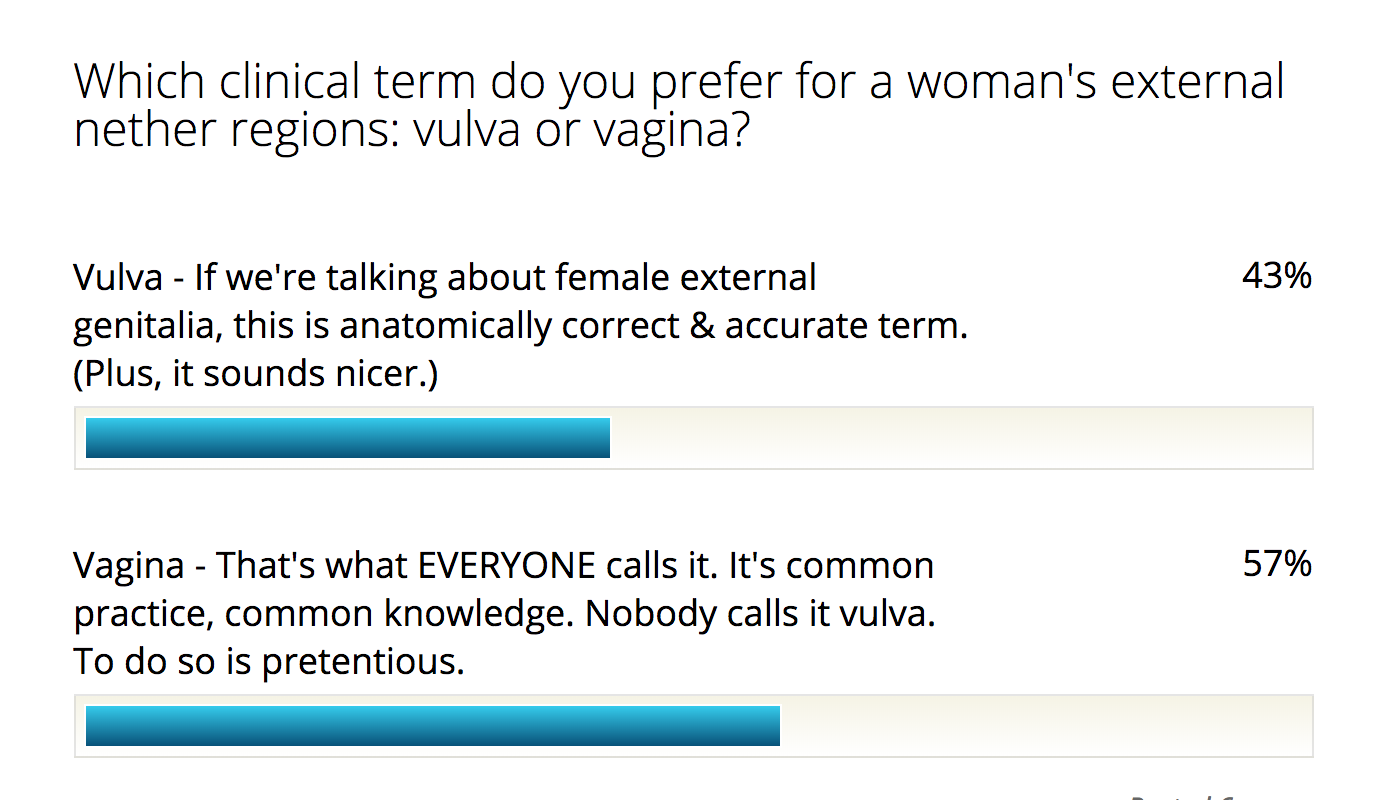
What happened? In trying to avoid leading the witnesses by making the vulva option too appealing (thereby revealing our preference), did I overcompensate and accidentally make the vagina option too convincing, relatively speaking? Did I inadvertently suggest to readers that if they voted for “vulva,” that meant they were automatically pretentious, thereby ensuring that a majority of hip, down-to-earth, unstuffy readers would choose “vagina”? Or did they just genuinely feel this way?
Those decidedly in the vagina camp usually share the views of those expressed in articles like “I Don’t Care About Your Stupid Vulva, It’s All Vagina to Me“: “All of our [lady] parts deserve attention, respect, and care—our vaginas, our vulvas, our clitorises, our labia….But that doesn’t mean it’s disrespectful to use a catch-all shortcut when I need to refer to all of those beautiful miracles at once.” The anti-vulvers usually argue:
- “Vagina” is funnier, more confrontational and more exciting than “vulva” — key for an entertainment writer who is not an anatomy textbook writer.
- “Vagina” has linguistically evolved to mean all lady parts.
- “WHOOOOO CAAAAAARES?”
Then they usually conclude by disrespecting all the gentle defenders of correct terminology with a bunch of so-mature name-calling.
[Deep breath.] Who cares? Really? Well, if the number of people who profess to want gender equality, bodily integrity, and sexual agency is any indication, then the answer is — or at least should be — a whole hell of a lot.
If the pro-vadges argued in favor of using a fun, funny, catch-all nickname for the general female genital area (both inside and out), I’d be all for it. In her book “How to Be a Woman,” British writer Caitlin Moran expounds on the tricky business of nicknaming one’s vagina. Moran — who, ironically but not surprisingly, conflates the two things, using “vagina” for both the birth canal and the external vulva — prefers the term “cunt.” Now there’s a word that’s truly confrontational! She writes:
If I tell you what I’ve got down there, old ladies and clerics might faint. I like how shocked people are when you say “cunt.” It’s like I have a nuclear bomb in my underpants or a mad tiger, or a gun.
Even though Moran hates on the word “vagina” and therefore inadvertently ends up kind of self-hating, she takes what’s often considered the grandmammy of female slurs, flipps it around, and uses it for her own personal and sexual empowerment! And because it’s slang — unlike the clinical, anatomically correct word “vagina” — “cunt” has the fluidity to encompass all lady parts, much like many other fun nicknames could too.
The average vagina-as-catchall defender may not be writing anatomy textbooks, but they can’t escape the fact that vagina is an anatomical term, with a specific definition — one that is not going to change any time soon. And it shouldn’t change: it is what it is. Nobody would consider trying to change the meaning of “penis” to encompass the testicles because 1) everybody is well educated (and unconflicted) about the anatomy of dudes, and 2) they mean two distinctly different things! When you visit your gynecologist, saying you have vuvlar pain does not mean you have deep, internal vaginal pain. And anatomical literacy can be helpful not only in terms of your health, but in terms of your sex life!
Words matter. They influence people’s — especially young people’s — ideas about the world, ideas that can shape the way people treat each other, ideas that can affect the way we think about our bodies, ourselves.
To further explain why getting it wrong matters, I turn to Joyce McFadden, psychologist, researcher and author of the book Your Daughter’s Bedroom: Insights for Raising Confident Women, who wrote the following in an article called “How Do We Influence the Women Our Daughters Become?“:
If our little girls are raised to believe that boys have a penis but girls have a “down there,” we need to understand these girls will likely grow into women who, even in the new millennium, confuse their vulvas with their vaginas. Along the way, they’ll be at risk of seeing their bodies as the property of boys because they haven’t been supported in developing a sense of ownership over their own bodies, and this will put them at risk of unintended pregnancy as well as make them more susceptible to not knowing how to advocate for their safety in potentially dangerous situations. And ultimately, they’re more likely to end up in long-term relationships or marriages in which they’re sexually unhappy.
McFadden interviewed hundreds of women for her project, and she was shocked to discover how so many adult women didn’t even know the word “vulva,” let alone what it meant. And in her studies, she found that this kind of ignorance led to feeling uncomfortable about female sexual issues, which meant their kids grew up feeling uncomfortable about them, too.
A professor of sexology (I can’t remember who) once said in an interview: “Imagine how the world would be different if people were told, starting from a very young age, that the female equivalent of the penis was the clitoris.” (And it’s true: anatomically speaking, the penis is just an overgrown clit.) Chances are, women would be more fully accepted as active, sexual creatures with their own physical desires, rather than widely thought of as passive objects of desire for hetero men.
As my daughter has grown up, I’ve taught her that she has a nose, not a honker. She has eyes, not peepers. When she goes to the bathroom, she wipes her vulva. The hole her poop comes out of is an anus. She knows that I get a period, that all grown women do, and that’s it’s natural and normal. Her younger brother knows, too.
When my daughter asked what that little nubbin of hers was when she was two or three, I told her: it’s a clitoris. I was horrified to learn that when Em’s daughter first asked her the same question, Em initially panicked and called it a “twinkle.” I’m happy to report that, after seeing McFadden speak in person, she’s come over to anatomically correct camp.
Our daughters may eventually be ashamed of us, but if we have anything to do with it, they will not be ashamed of their bodies — vulvas, vaginas and all!